Many people will tell you the whole point of the cloud is that you only pay for what you use. That’s a neat idea and one of the first things a cloud salesperson will tell you. I’m here to tell you about another way to think about it though, a more subtle and powerful way. And once you see it, you’ll see the power of FinOps more clearly too.
To get there, we need to talk about supply chains.
Every Industry Goes Through Similar Phases
At the start, most new industries are doing something that’s technically difficult. At some point, we solve most of the technical issues, which changes the conversation from “how (do we do this)?” to “how much (should we put in our product)?”
Rubber is a good example. It’s really hard to make a car without rubber. It’s not just the tires but bushings, hoses, seals and a hundred other small parts rely on a reliable, high quality supply. Even to this day, high quality natural rubber remains a challenge to grow at scale, which is why some large auto companies used to run their own plantations. Ford in particular owned extensive rubber interests in Brazil before WW2. (Sounds familiar? If you’ve ever had a data center, it should.) And then one day we figured out how to manufacture synthetic rubber, in volume, at quality.
Something interesting happened once the technical problems were solved. We stopped asking “where do we get this? Will it work? Can we rely on them?” and instead switched to “How much do we need?” And other questions like “how do we ensure good quality”, “what are the commercial terms?” and “what’s the benchmark price for this?” and a hundred other items.
And it’s not just about driving down costs. More rubber might make for a better ride. It might let you raise prices, sell more cars, sell them quicker, reduce delays in your supply chain or take a chunk out of someone else’s market share. The interesting answer is rarely “the minimum” but figuring out “the right amount to win” is almost as difficult a problem as the old question of “how do we do this”.
Welcome to the world of supply chain inputs and outputs.
The Toyota Camry
Let’s take a look at a real world example with one of the pioneers of supply chain management, Toyota. In the US, adjusted for inflation, a Toyota Camry today costs roughly the same as thirty years ago. Yet the new one has airbags, ABS, stability control, air conditioning that actually works, a screen that can find you a petrol station in a strange town, crumple zones, better fuel economy and a cabin that doesn’t smell like hot plastic by the end of a summer drive.
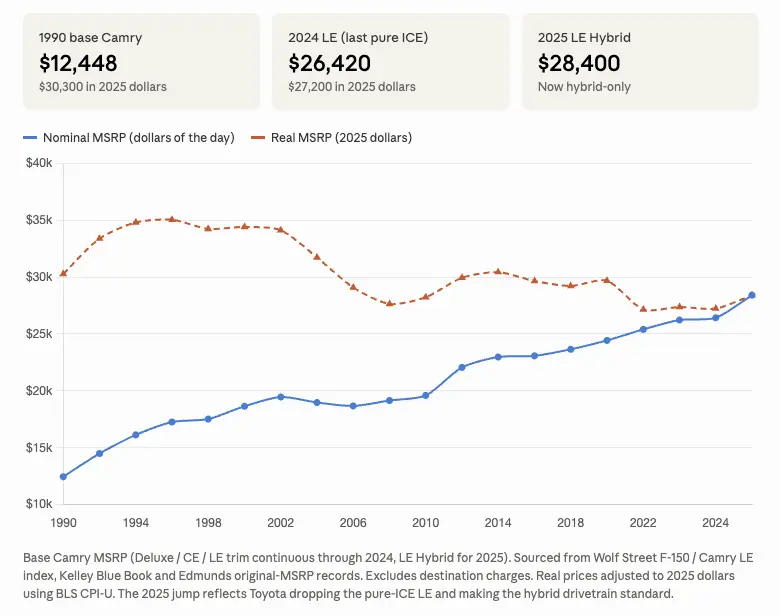
Same cost, dramatically more car. How?
The answer is specialization. When we specialize, we make more products at a better quality. A supply chain can take advantage of this in a way that doing it yourself does not. Economists call this comparative advantage, and it is the quiet secret to modern prosperity.
If we think about this in our own lives, imagine you have a passion project, something you really care about: gardening, wine making, baking, etc. You likely have years of expertise and equipment and could out cook or out dig most of your friends, just like they are good at their own specialty hobby too. And if each of you stick to what you’re best at and trade flowers for cookies or whatever the exchange is, it’s obvious you’ll get higher quality and more volume than if you each spent some time trying to replicate the other’s special skills and gear. On one level, it’s just common sense.
Back to the Camry. In the same light as you sticking to what you’re good at, Toyota no longer makes its own wheels, forges its own steel nor spins its own airbag fabric. It even buys complete sub-assemblies (whole gearboxes, whole seat systems) from specialists who do nothing but make that one thing and who are very, very good at it. Each of those specialists buys their inputs from more specialists further up the chain. And at every level, the people doing the work are better at it than a generalist would be, which means the quality goes up and the cost comes down at the same time. In fact, the wheel companies make more wheels than any one car company ever could.
It’s not just cars, many other every day items also benefit from this, toys, clothes, power tools, TVs and many others. Take your toaster, washing machine or microwave. They are all cheaper and more heavily featured and if they still existed, you’d say the same about video recorders, hi-fis, camcorders and fax machines.
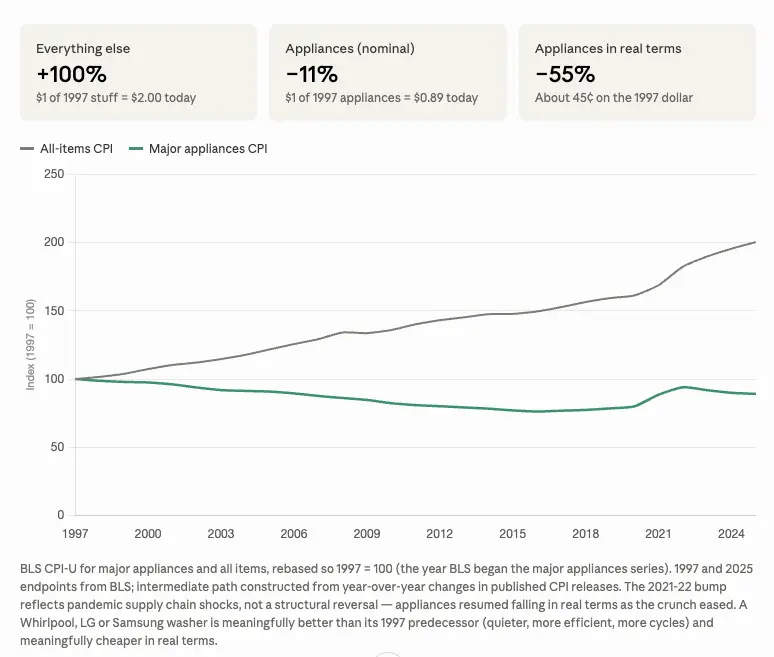
Humans have a genuinely hard time believing this, because it sounds too good to be true. More stuff, for less money, at higher quality, all at once? Surely there’s a catch. But there isn’t, really. It’s real and the Camry demonstrates comparative advantage at work.
The catch, if there is one, is just that you have to be willing to let someone else do the things they’re better at than you.
The Cloud is Just Another Version of This
Which brings us, finally, to the cloud.
Running your own servers used to be how it was done, because there wasn’t another option. You bought the hardware, you built the data center, you hired the people, you paid the power bill. You did it all yourself because you had to. Anyone who tried to rent you this stuff would be constantly fixing things and cost so much trying to keep things going it would ruin them. In fact, you could rent servers back then, but they were clearly more expensive and meant only for very specific situations.
As the technology matured, reliability improved and it became possible to offer some of these technologies as a service. Storage and compute at first and now, over 20 years later, we have all kinds of services available, from email delivery to invoicing to whole sub-systems.
To come full circle, the reason you rent compute from Amazon isn’t really because you don’t want to pay for idle servers. It’s because Amazon is better at running servers than you are and letting them do it gives you access to better technology at a lower price. (It also frees up your time to focus on your actual business, but we’ll cover that another time.) Same as Toyota and wheels. Same as car makers and rubber. Old idea, new industry.
There are exceptions of course, which broadly fall into three categories.
Still Critical to You. At Dropbox, storage is a key economic driver for their business. I’m still pretty sure they don’t deploy more storage than Google or Apple, but they need to be in control of this and so they build their own specialist architecture to meet their customers’ needs in a way cloud providers will probably not match for a while given their broader focus.
Still Early. The very latest stuff is still hard. LLMs, multi-card CUDA, quantum, optical and many other hyperscale technologies are still being developed. If you rely on this stuff, you’re probably hosting it yourself. Maybe you use Amazon because they have more GPUs or megawatts than you can source, but boy, you know you’re paying a premium.
Still Difficult. Not every problem has been solved. Not every database can work with infinitely large data sets. Not every architecture is cloud compatible. However, in my opinion, there are more systems out there that use this reason as an excuse to stay off the cloud than I think is strictly necessary. Their loss, not mine.
Toyota still paints its own cars, because shipping a half-built car somewhere to get painted and back again breaks the economics. If you’re a big enough consumer of a thing or the logistics of third parties letting you down are ugly enough, insourcing wins. But for most of us, those are the edge cases, not the rule.
Compute is a Weird Supply Chain
So if the cloud is a supply chain, how is it so different we have our own word for it? Why does it feel so much harder than buying a bunch of nuts and bolts?
Cloud supply chains have some unique features that others do not:
Instant. You press the button, it’s here. No time to review the invoices or change your mind. No sending it back.
Invisible. If you order too many bolts, you know about it, they sit there cluttering up your warehouse. But when a script goes off and starts 10,000 servers, you won’t know until the bill lands.
Perishable. When you buy a compute hour and don’t use it, it’s gone. You can’t put it on the shelf or wait until you need it. You can’t return it.
Infinite. You can easily order many times more than your business can afford.
Combine any two of these and it’s a challenge, but all four? It’s a particularly difficult combination that has been one of the main things slowing down cloud adoption since its inception.
These four things together mean the normal supply chain feedback loops (the ones that have kept manufacturers honest for a century) are not anywhere as effective with the cloud. You have to do something else, which is where FinOps comes in.
Rethink
Armed with this new knowledge (it’s a supply chain) you can now take your existing FinOps skills to the next level. There is still much to learn from every other industry who have been doing this, sometimes for decades. You can even get a PhD in it, where it’s known as “operations research”. Most of the discussions I hear around FinOps have answers or at least ideas already tested in other industries.
And don’t forget about our own four horsemen of the over-spend apocalypse: instant, invisible, perishable, infinite. These are where our own special skills come in to play.
Once you make the leap from cloud cost management (cost cutting, containment) to FinOps (sophisticated management of inputs and outputs within a supply chain framework) you can move at a different speed and with much greater agility. Engineers, finance and the business can all speak the same language, which increases alignment and reduces decision friction. And you can get away from the instinctive urge to simply ‘spend less’. Imagine the CEO of Toyota being told “our steel bill was up 50% last year” and it meant there was a 50% jump in sales?
We’ll talk in future articles about the power of unit costs, bills of materials, benchmarking and all the other secret stuff we can learn by studying other supply chains, but for now, take another look at your FinOps dashboard and, with any luck, you’ll see it in a whole new light.