Most companies don’t need a FinOps practice. The trick is knowing whether yours is one of them and if it is, knowing what kind. I’ve spent a good part of my career trying to explain to budget holders why reducing cloud waste is worth their attention, and there are plenty of reasons they push back. So one day I sat down and sketched a FinOps edition of the conjoined triangles of success to help frame the conversation. To me it makes things clear. More than one person has told me it might do the opposite. You decide:
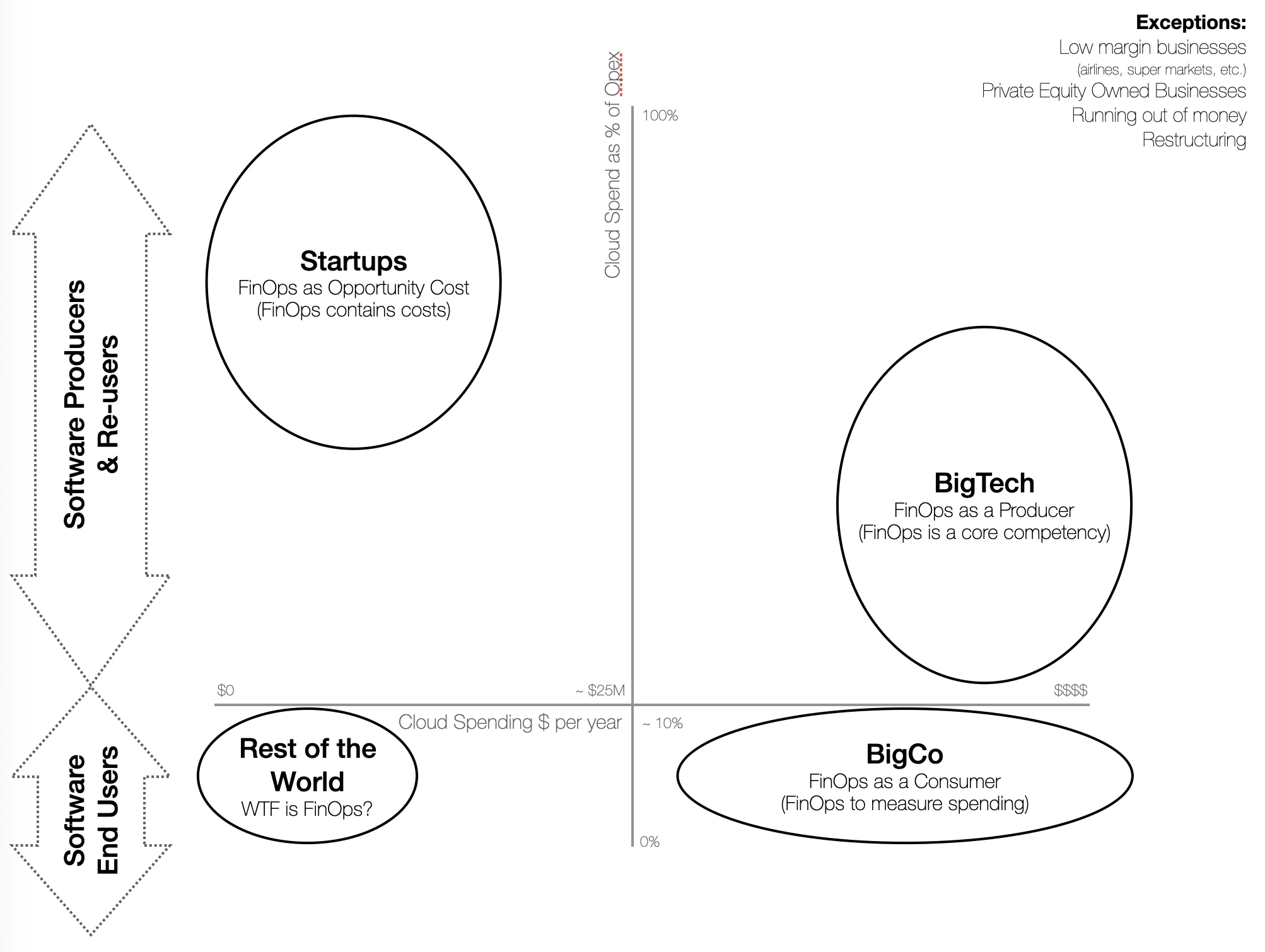
The chart is simple. The numbers don’t matter much but I’ve picked some ranges for clarity. The x-axis is annual cloud spend, from $0 to infinity, crossing the y-axis around $25M. The y-axis is cloud spend as a percentage of total opex, from 0% to infinity, crossing somewhere in the low double digits. There’s also a vertical axis on the left I’ll come back to: whether you’re a software producer or a software end user.
Let’s start with the lower half.
Rest of the World (WTF is FinOps?). If you’re spending less than a few million annually and it’s less than 10% of opex you don’t really need to worry about FinOps. Go do something more important. This is the vast majority of cloud users. Cloud isn’t the most important thing in your business by a long way.
BigCo (FinOps as a Consumer). If you’re spending more than a few million annually but it’s still less than 10% of opex you should track this, but the way you track your phone bill. Write it down, set budgets and have a quiet word with anyone who blows through them. Anything more isn’t going to move your needle. This is a good chunk of cloud spending. Cloud is helpful but it’s just another expense, like office space or the company health plan.
Not very interesting from a FinOps perspective. The upper half is where it gets useful.
Startups (FinOps as Opportunity Cost). If you’re spending less than $5M or $10M a year but it’s more than 10-20% of your opex you’re probably a VC-funded tech startup or a bootstrapped business. You’re likely quite inefficient with lots of legacy stuff lying around and nobody dedicated to tidying it up. I’ve seen waste rates up to 50 cents on the dollar. But fixing it has a real opportunity cost: everyone working on optimizing your spending is someone who’s not growing the top line. You might bring in an outside person to identify the easy wins but many companies just ignore it until one of three things happens. Funding runs out. Growth kicks off. An investor balks at the gross margins. Running inefficiently is fine so long as you do it intentionally. Don’t tell yourself you’re special or already perfectly optimized or any other of the self-deluding excuses for not acting. Own it, measure it and make an intentional choice to trade cash for speed.
BigTech (FinOps as a Producer). If you’re spending more than $10M a year and it’s more than 10-20% of opex I sincerely hope you have a FinOps practice. I’ve talked to companies in this quadrant who told me “we’re making too much money to bother” or “we’re growing too fast for that.” At this size a FinOps team easily pays for itself several times over, even accounting for the management and architectural bandwidth it consumes. It’s a simple financial equation: pay for yourself many times over without causing too much bother and you keep your jobs. And you will have to address this eventually. The bills never go away. At some point it hits the executive radar, and you don’t want to be the person associated with that much wasted spend.
The producer/consumer axis. Look at where the upper-half quadrants sit. Companies in the top half can be viewed as using cloud as a raw material, processing it and spitting it out as their product, a bit like Nike might take cotton and rubber and turn it into a sneaker. That’s why FinOps shifts from being a measurement function (BigCo, tracking spend) to a core competency (BigTech, where efficiency is a product feature you can weaponize against competitors). This is the bit most internal arguments miss. If your cloud bill is the raw material going into your product, FinOps isn’t a back-office tidy-up exercise, it’s margin engineering.
The transition is where careers are made or lost. Moving from Startups to BigTech is the most important shift on this chart. I’ve seen every kind of resistance to it. “We’re fine.” “We don’t have time.” “Is this really that big of a deal?” The reality is that once you reach scale, efficiency lets you offer more than your competitors for less. Comparative advantage rears its head again. Don’t assume you’ll never have to do this. Either do it first or watch a competitor do it to you.
Exceptions. The grid has some, which I’ve parked in the top-right corner of the diagram. Low-margin businesses (airlines, supermarkets) and private equity-owned businesses tend to care about FinOps more than their cloud spend alone would suggest. Companies running out of money or under P&L pressure become believers too, though usually only temporarily.
Figuring out which quadrant you’re in is the essential first step before you start or expand a FinOps practice. I’ve seen folks in the lower half burn out trying to get support that was never going to come and folks in the upper half lose arguments to colleagues who’d rather not deal with it (sometimes for defensible reasons). Knowing whether you’re tilting at windmills is worth doing before you sink a few years of your career into doing the right thing.